
Start the Pixel Lineage Mage class with a staff, practice the basic Attack’s Arcane Sigils timing, and keep Energy available for Guard. Use Mage’s Sense before an attack you can take within two turns, then account for its two-turn damage penalty. Learn the starting kit before copying an advanced Archon build.
Quick Guide
- Choose Mage, then use Set Out for your first run.
- Attack → press Space/click as the frame locks onto each rune.
- Sense costs 1 Energy: plan the next attack and the later penalty.
- Guard costs 1 Energy; held Energy matters for its barrier.
- Treat spell learning, equipped Scroll items and Super/Ultra promotion separately.
Mage → Summoner → Archon: your next step
MageSummonerArchon
Choose the stage that matches your hero. Finish its action before moving to the next stage.
Choose Summoner at the shrine
You need: A Mage hero and the Dungeon trainer event.
- During a Dungeon run, look for the Forgotten Dojo / Trainer’s Shrine event and open the class previews.
- Choose the Summoner preview. Read its moves and the permanent-choice warning before confirming.
Your Super branch is Summoner and its move appears in Skills. A castle card saying “Mage” alone does not confirm the branch.
Already chose Cleric or Hexer? Stop here. This Archon route requires Summoner; an Archon Sigil does not replace the Super choice.
Resource plan: Keep usable gear and learn your starting kit first. The reviewed menu does not establish a minimum hero level or a guaranteed shrine floor.
Open the Super class menu guide19 Oct update: the official title now includes Spear Class + Dragon Race. This route uses reviewed Mage / Archon footage and has not been replayed on that update. Stop if the live item requirements or actions differ.
On this page
- Weapon
- Staff
- Preview role
- Elemental spell specialist
- Difficulty label
- Medium
Pixel Lineage Mage class: staff, timing and Energy
The Pixel Lineage Mage class uses a staff and turns Energy into spell options and protection. Start by learning the Arcane Sigils timing prompt on your basic Attack, then decide whether the next turn needs damage or Guard. Use Mage’s Sense when you can follow it with a damaging attack inside its two-turn window; the damage penalty afterward is part of the decision.
The class-selection screen labels Mage Medium and describes a fragile caster. Its five power bars do not mean five times another class’s damage, and the lower defense bar is not an armor value. If you are still choosing a starting kit, the class comparison explains the other five roles without treating those preview bars as a tier list.
| Preview field | Shown value |
|---|---|
| Weapon | Staff |
| Difficulty | Medium |
| Power / defense / speed / support | 5 / 2 / 3 / 2 bars |
| Starting progression | Mage → one Super branch → matching Ultra |
Choose Mage and enter your first run
At character creation, browse the class cards with A/D or the arrow keys until MAGE and WIELDS A STAFF appear. Read the right-hand Mage’s Sense description and the passive line beneath the character, then confirm the displayed BECOME A MAGE action or the shown Enter instruction. This selects a new hero’s starting class; it is not a respec operation for an existing character.
The first-run example then returns to the castle and uses Set Out → Play Solo. Check your current hero before leaving, and use the beginner guide if the route or battle menu is unfamiliar. Having a staff appearance or an advanced item in another hero’s inventory is not the same as choosing this class.

Arcane Bolt, Mage’s Sense and Mage Barrier
The filmed level-1 Mage uses Arcane Bolt through the basic Attack action. A separate Character → Skills tooltip calls Arcane Bolt a basic attack, marks Energy FREE and cooldown NONE, and says it scales with Arcane. That tooltip belongs to a level-50 hero: its displayed damage must not be copied into a new character’s expected hit.
Pebble Throw still appears in another selection description and in the community spell list. Those names do not establish that Pebble Throw is the basic Attack in the first-run recording. Keep the observed Arcane Bolt action, the starting buff and later spell-learning progression separate rather than replacing one with another because both sound magical.
| Tool | Known action / cost | What to expect |
|---|---|---|
| Arcane Bolt | Basic Attack; separate skill tooltip says FREE / no cooldown | Arcane scaling; perform the timing prompt |
| Mage’s Sense | Skills; shown cost 1 Energy | Next damaging attack within 2 turns +15%; then −15% for 2 turns |
| Mage Barrier | Guard; shown cost 1 Energy | Energy-linked barrier; current conversion ratio Pending confirmation |


Arcane Sigils: how to make the input
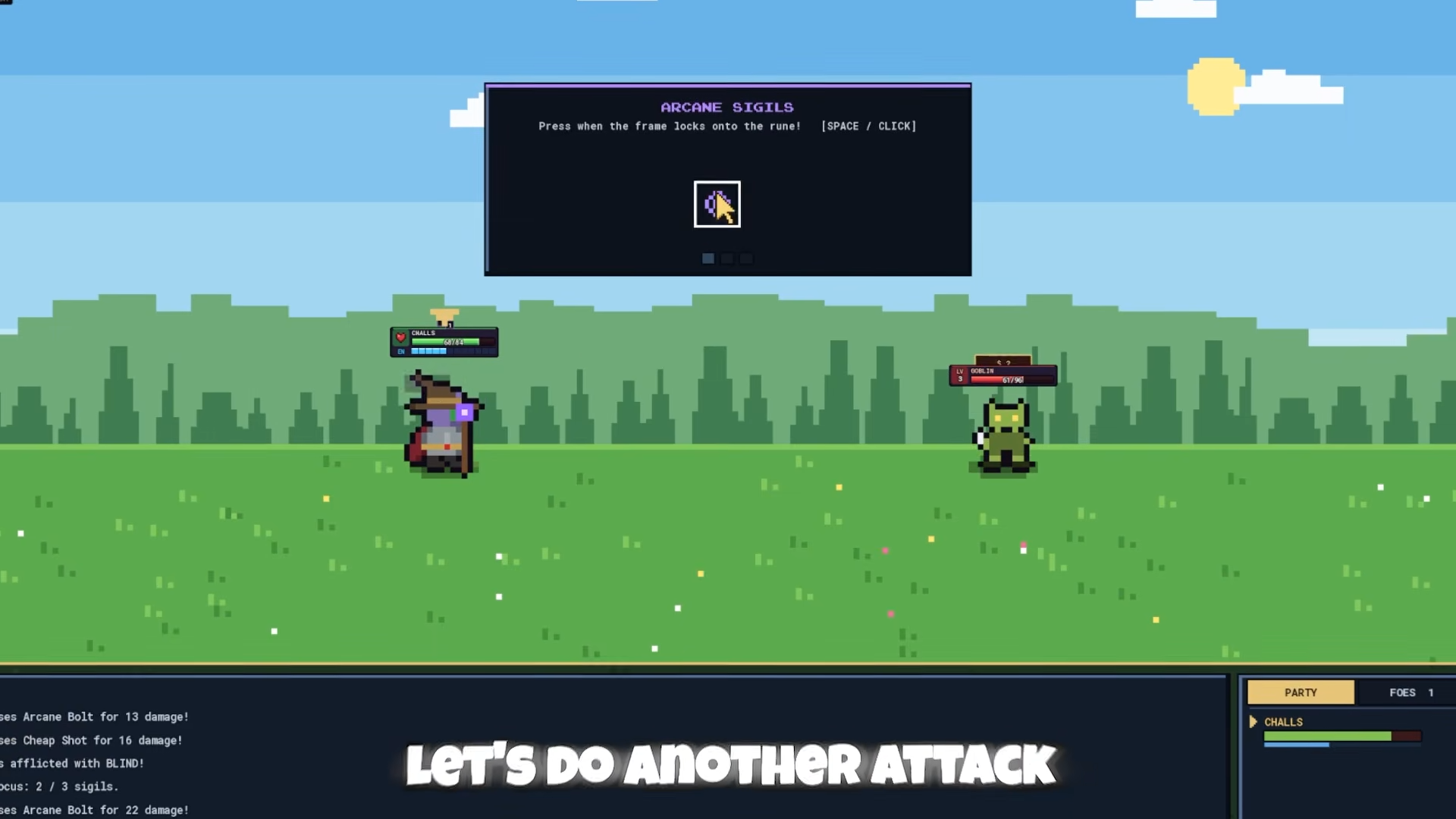
After selecting Attack, watch the Arcane Sigils panel. Its instruction is to press Space or click when the moving frame locks onto the rune. Follow the three input opportunities instead of clicking continuously as soon as the panel appears.
The feedback distinguishes partial results such as 2/3 Sigils from PERFECT CAST. The battle log then records the Arcane focus result and the named action. Use that feedback to judge your timing; a perfect input is not a promise of a critical hit, a fixed damage multiplier or an identical result against every enemy.
The incoming enemy prompt is different: it says to press as the attack hits the shield, with white labeled Dodge and blue labeled Block. Do not apply the offensive rune instruction to that moving defense bar. The controls guide keeps the broader battle input contexts separate.
Mage’s Sense: prepare one hit, then respect the penalty
The preview says your next damaging attack within two turns deals 15% more damage. After that attack, or when the Sense window expires, damage is reduced by 15% for two turns. Spending the action and then letting the window expire is therefore a poor setup when you had no attack ready to follow.
Use Sense only after checking that your intended damaging action is available and affordable. In the starter fight, the log shows Sense gained, a later Arcane Bolt and then “sense fades: Weakened for 2 turns.” This makes the drawback visible without pretending the sample proves every stacking rule or the best possible rotation.
If the enemy is about to force a defensive decision, reconsider buffing first. Guard and Sense both draw on Energy, and the buff does not restore HP. A useful damage window is one you can actually take, rather than a bonus counted on paper while your next action must be survival.

Guard with Energy: the rule and a real result
Mage Barrier costs 1 Energy and has no cooldown in the new player panel. Its Chinese description refers to Energy held before payment, but the absorption-number field is incomplete. The earlier source describes 10 damage per held Energy; that older wording is not independently confirmed by this new panel, so the current conversion ratio remains Pending confirmation.
The Forest Wisp example provides an actual result: the log records Guard costing 1 Energy, the barrier absorbing 7 damage, and Leaf Spark dealing 0. Seven is the incoming damage absorbed in that exchange, not the barrier’s universal maximum. The footage does not settle whether every calculation reads Energy before or after its cost, so this guide does not derive a hidden formula from the sample.
An incoming Block timing prompt can also appear during the enemy action. Treat that timing response and choosing Guard on your own turn as different decisions. A barrier animation alone does not prove the next attack will be harmless; read the resulting HP and combat log.

Spell scrolls and the equipped Scroll slot
The community Mage reference describes additional spells learned permanently from spell scrolls dropped by some foes, with learning restricted to Mages. It names the spells below, but the reviewed footage does not show obtaining one of these drops or pressing a learning button. Their exact current sources and learning sequence remain unconfirmed; this is a spell checklist, not a verified farming route.
This is also distinct from the equipment Scroll category. The Scrolls guide documents worn-slot items such as Focus, Blades and Renewal with battle effects. Equipping one of those items is not evidence that you permanently learned Fireball or Meteor. Read the actual item description and the resulting Skills list before treating an equipped scroll as a learned spell.
| Community-reported spell | Reported use |
|---|---|
| Pebble Throw | Earth single-target spell |
| Water Bullet | Water single-target option |
| Stone Skin | Defensive buff |
| Fireball | Fire single-target attack |
| Icicle | Multi-hit ice attack |
| Ice Blizzard | Ice field effect |
| Meteor | High-Energy fire burst; special timing claims not verified here |
A practical first-run priority
For your first fights, choose a repeatable priority rather than a rigid three-button combo. Check incoming danger and HP first, then Energy and available actions, and only then whether Sense can support a real attack window. The starter clip succeeds with the basic Mage tools; it does not require a complete elemental spell book before you can learn the controls.
When improving equipment, compare staff compatibility and the actual offensive and defensive changes on your hero. Arcane appears as the scaling field for the observed Arcane Bolt, while the advanced Mage build explains one developed character’s stats, powers and equipment. Its level-50 allocation is a later example, not a mandatory starting point or a reason to ignore HP.
| Situation | Practical choice |
|---|---|
| Need to learn timing | Practice basic Attack and read the Sigils result |
| Damage action ready; safe follow-up available | Consider Sense before that attack |
| Dangerous incoming hit and Guard available | Compare Guard with the cost of spending more Energy |
| Sense penalty active | Reassess survival and current actions; do not count the bonus again |
Cleric, Hexer, Summoner and the Ultra step
The Mage selection screen names Cleric, Hexer and Summoner as its three Super branches. A community Super-class reference lists Mending Light for Cleric, curse-themed Hex moves for Hexer, and Familiar/Guardian/Phoenix summons for Summoner. Use those as directions for reading the actual branch preview, not as a tested ranking or a full build for each path.
The Super Classes guide covers the Dungeon trainer context and the permanent-choice warning. The separate Ultra unlock guide demonstrates the later Summoner → Archon route using the matching Sigil, with Tomes for skills II and III. A starting Mage, a selected Summoner and an awakened Archon are different progression states; finding an Archon item does not skip the matching-branch requirement.
Sources and footage were reviewed on 16 October 2026; the filmed game builds are unknown. The class inputs, Sense wording and Guard result have direct gameplay support, while the spell-learning list and branch themes retain their community-source scope. Complete spell drops, all branch skill kits and a universal strongest-Mage recommendation are not established by these materials.
For the Archon route, the Dragon Gate unlock guide separates the initial Sigil awakening from the later Tome skill.
The Mage menu also lists Cleric, Hexer and Summoner as Super paths: Cleric previews Smite, Mending Light and Judgment before Seraph; Hexer maps to Doomcaller; Summoner previews Arcane Familiar, Stone Guardian and Phoenix Call. Use these names to choose which branch to inspect next; keep the Mage starter guide for the current combat basics and check the live requirement before committing. See the [Super Classes guide] for the branch map.
Pixel Lineage Mage Class: the captured skill panels
The newer level-50 menu separates free basic actions from Energy skills. Arcane Bolt is FREE with no cooldown; its 7,517 damage belongs to that character. Mage’s Sense costs 1 Energy, has a 4-turn cooldown and does not scale with attributes.
Mage Barrier costs 1 Energy with no cooldown. The newer Chinese-client description says that before payment, every 10 Energy held blocks 1 damage, with overflow affecting HP; this differs from the older wording. Treat that as the displayed sample, not a newly measured universal absorption formula.
Meditate is FREE with no cooldown and uses your turn to gain 1 Energy without defending. Pebble Throw’s pictured spell costs 2 Energy and has a 2-turn cooldown; the description weakens one enemy’s damage by 15% for two turns. Its 13.0K damage and Arcane Bolt’s number are menu samples, and this panel does not prove every new Mage begins with every listed spell.



Frequently Asked Questions
Is the first basic attack Arcane Bolt or Pebble Throw?
The filmed level-1 Mage uses Arcane Bolt through Attack. Pebble Throw appears in another preview and the community spell list; those records do not replace the observed basic action.
Why did my damage fall after Mage’s Sense?
After the boosted attack or after the window expires, the displayed rule applies −15% damage for two turns. The sample log names this Weakened.
Does equipping a Scroll teach a spell permanently?
The equipment Scroll slot and community-reported spell-learning scrolls are not proven to be the same operation. Check the item wording and your Skills list; a worn-slot change alone does not prove a learned spell.
Sources
Reviewed:
Player-supplied Roblox UI reviewed 2026-10-18; exact game build unknown
New player screenshots reviewed 18 October 2026. Exact game build unknown; older sources keep their original scope.